From Framework to Founding: Leading AI-Native Product Design
A leadership framework showing how AI is reshaping product design, team operations, discovery, and enterprise innovation.
Designing a connected ecosystem of AI-native products that transform how product design and engineering teams collaborate, think, and scale in the age of intelligence.
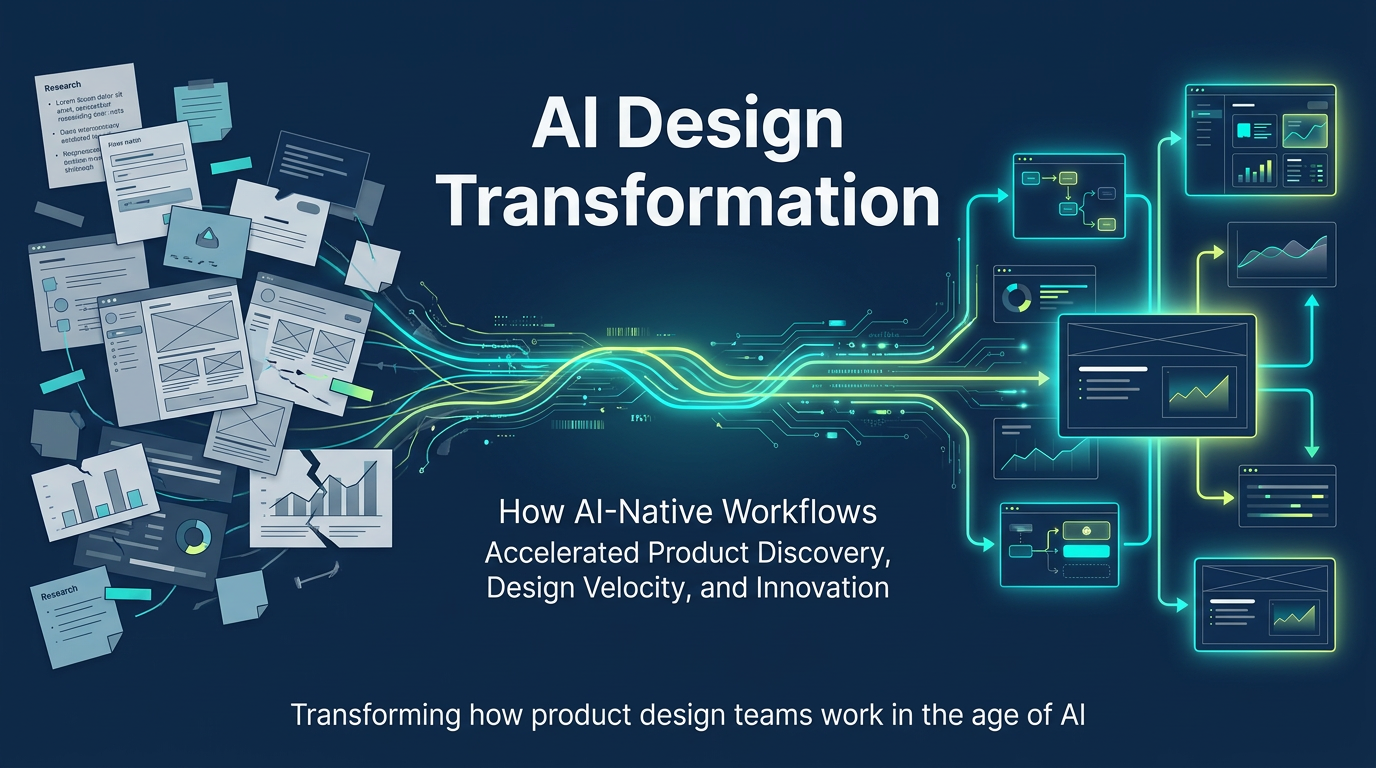
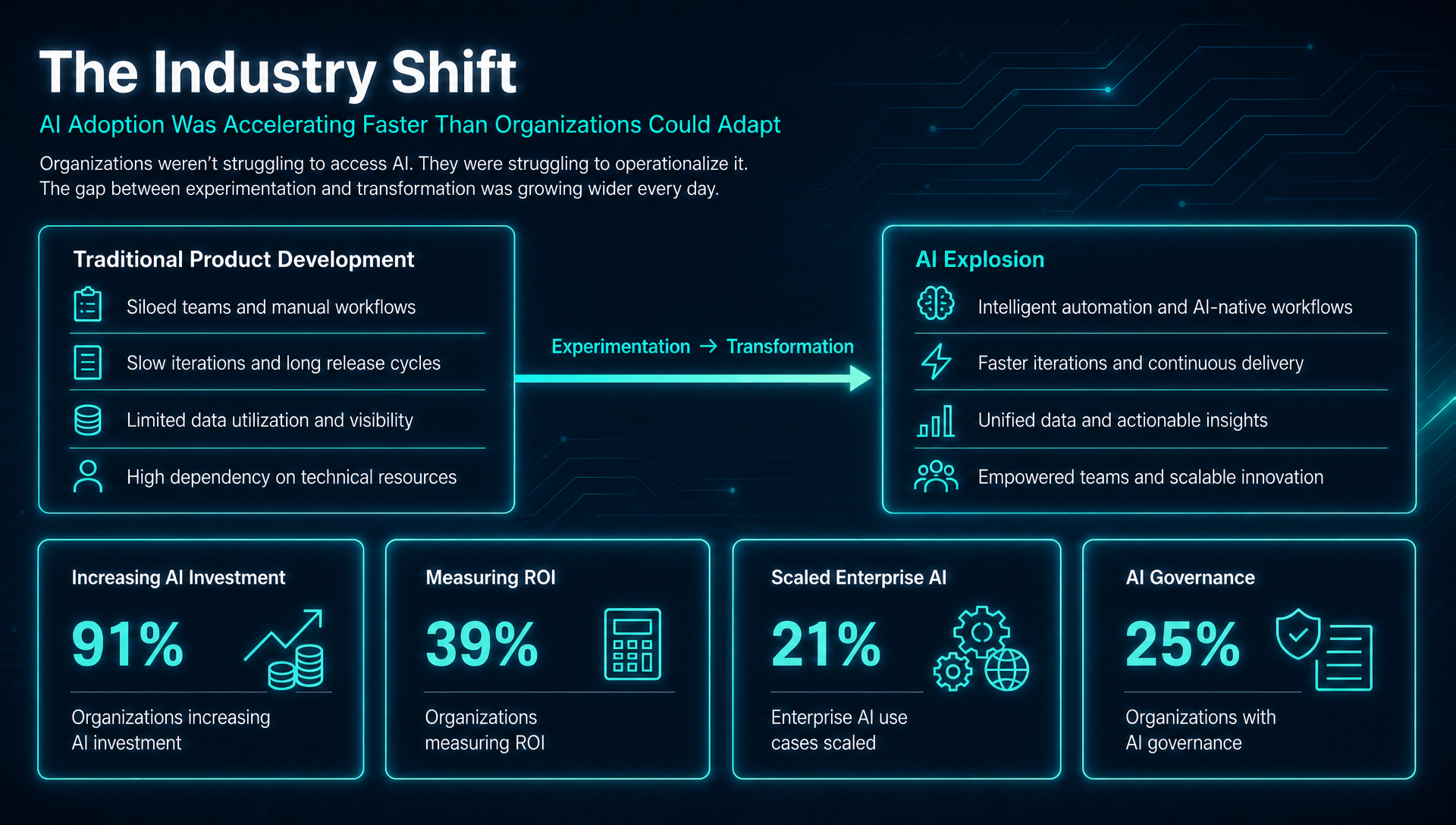
AI adoption was accelerating faster than organizations could adapt.
Organizations weren't struggling to access raw artificial intelligence. They were struggling to operationalize it. The gap between experimental sandboxes and real product transformation was growing wider every day.
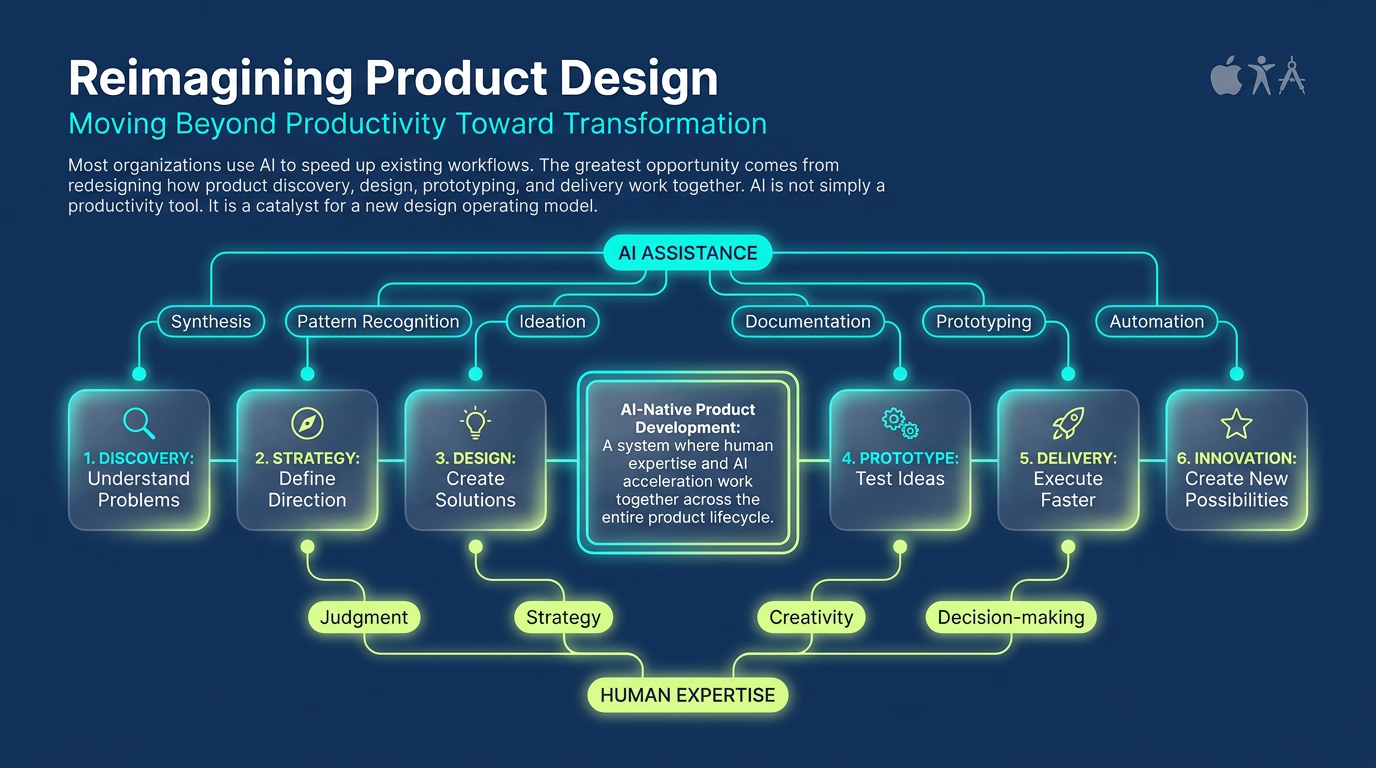
Moving beyond productivity toward transformation.
Most organizations use AI to simply speed up existing legacy workflows. The true strategic opportunity lies in completely redesigning how product discovery, product strategy, UX design, prototyping, and engineering delivery operate as a unified system. AI is not just a tactical utility, it is the foundation of a brand-new design operating model.
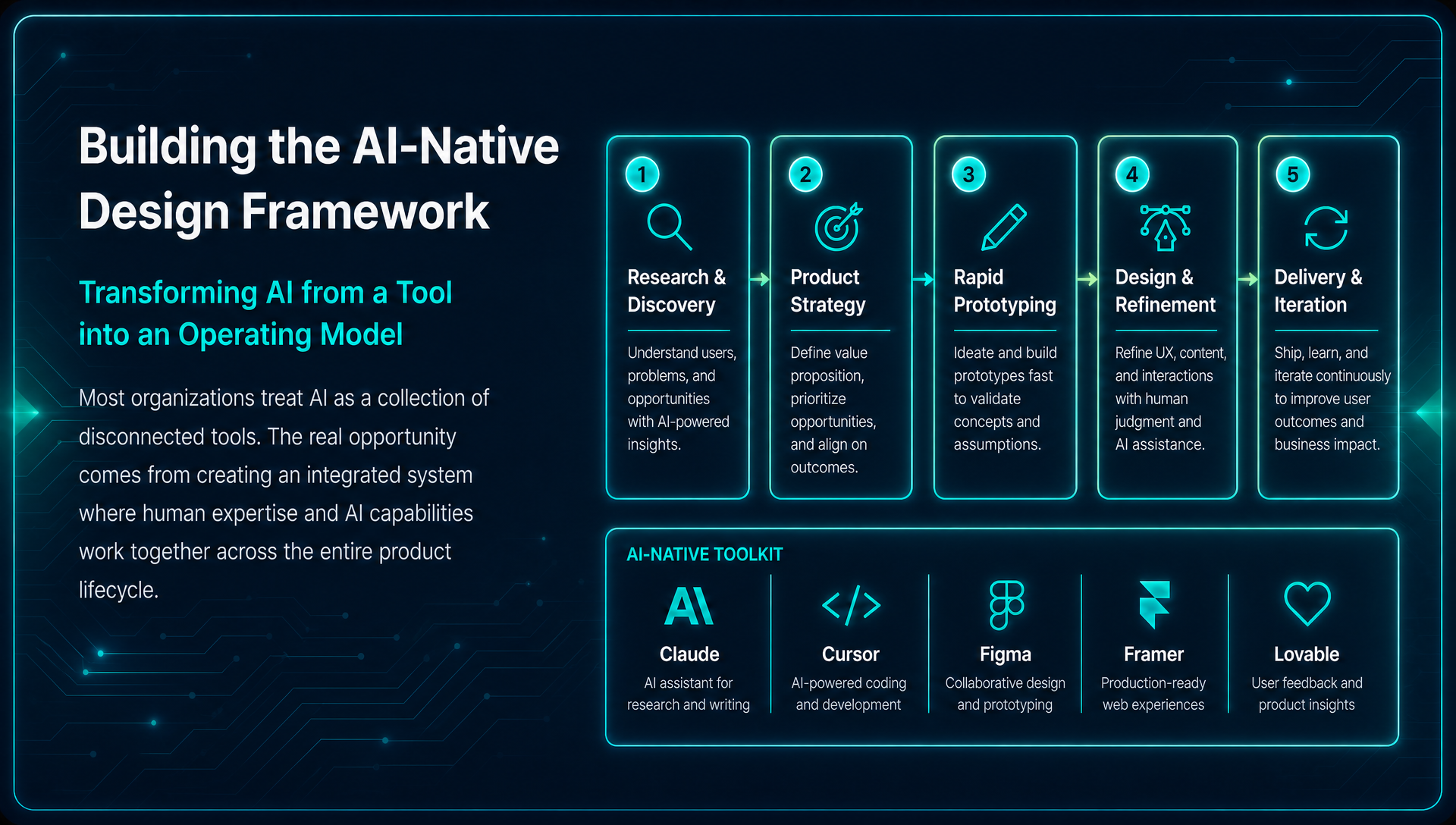
Building the AI-Native Design Framework
Transforming AI from a tool into an operating model.
- Human-centered core prioritizing strategy, judgment, creativity, and leadership.
- Tight integration of industry-leading models and tools (Claude, Cursor, Figma, Framer, Lovable) inside continuous feedback loops.
- Dedicated analytics and validation layers to drive better, data-backed decisions.
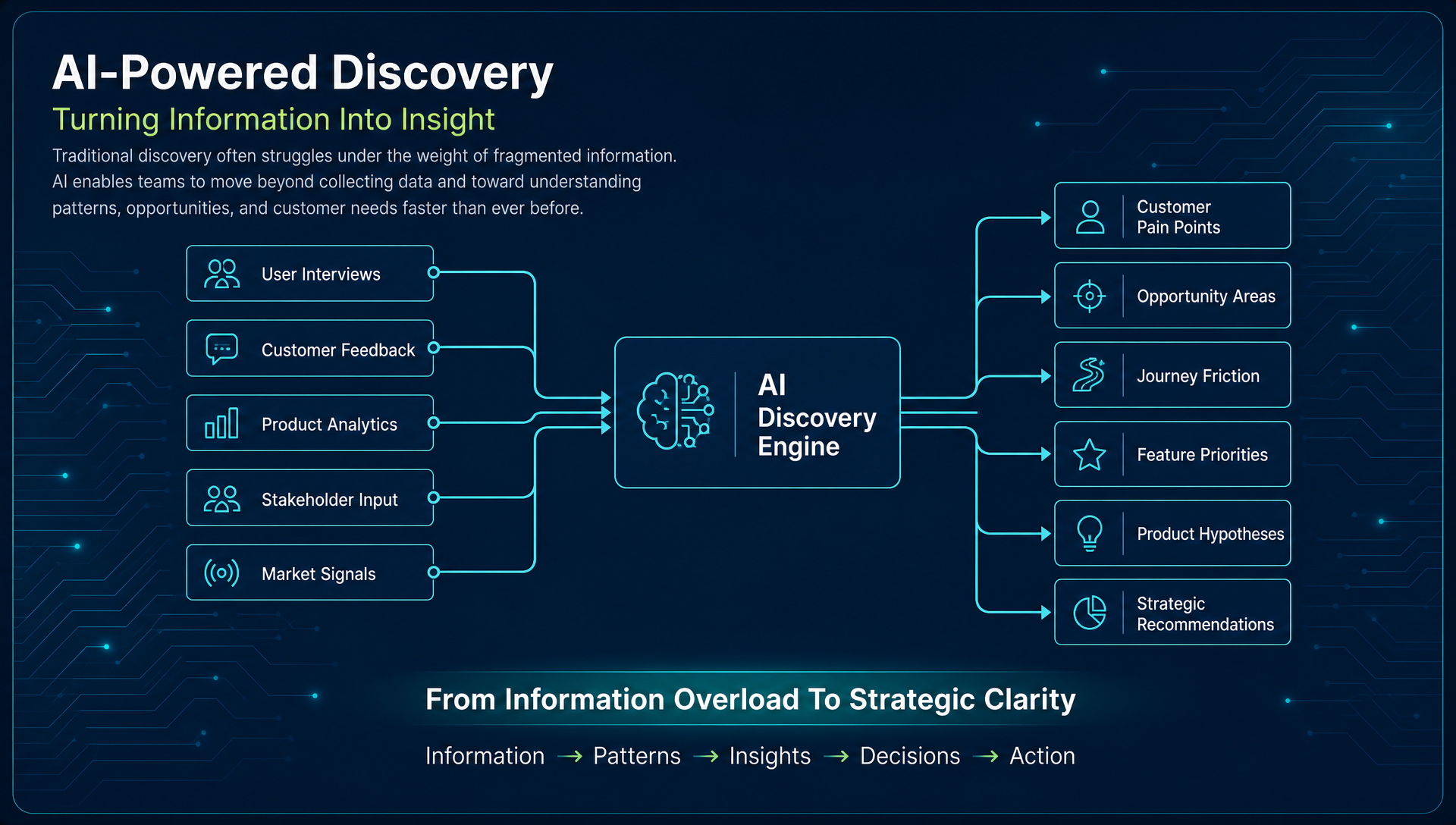
AI-powered discovery, turning information into insight.
Traditional product discovery often collapses under the weight of unstructured, fragmented data. By utilizing AI-native synthesis engines, teams can seamlessly ingest diverse inputs to extract clean, actionable strategic recommendations faster than ever before.
- User Interviews
- Customer Feedback
- Product Analytics
- Stakeholder Input
- Market Signals
- Customer Pain Points
- Opportunity Areas
- Journey Friction
- Feature Priorities
- Strategic Recommendations
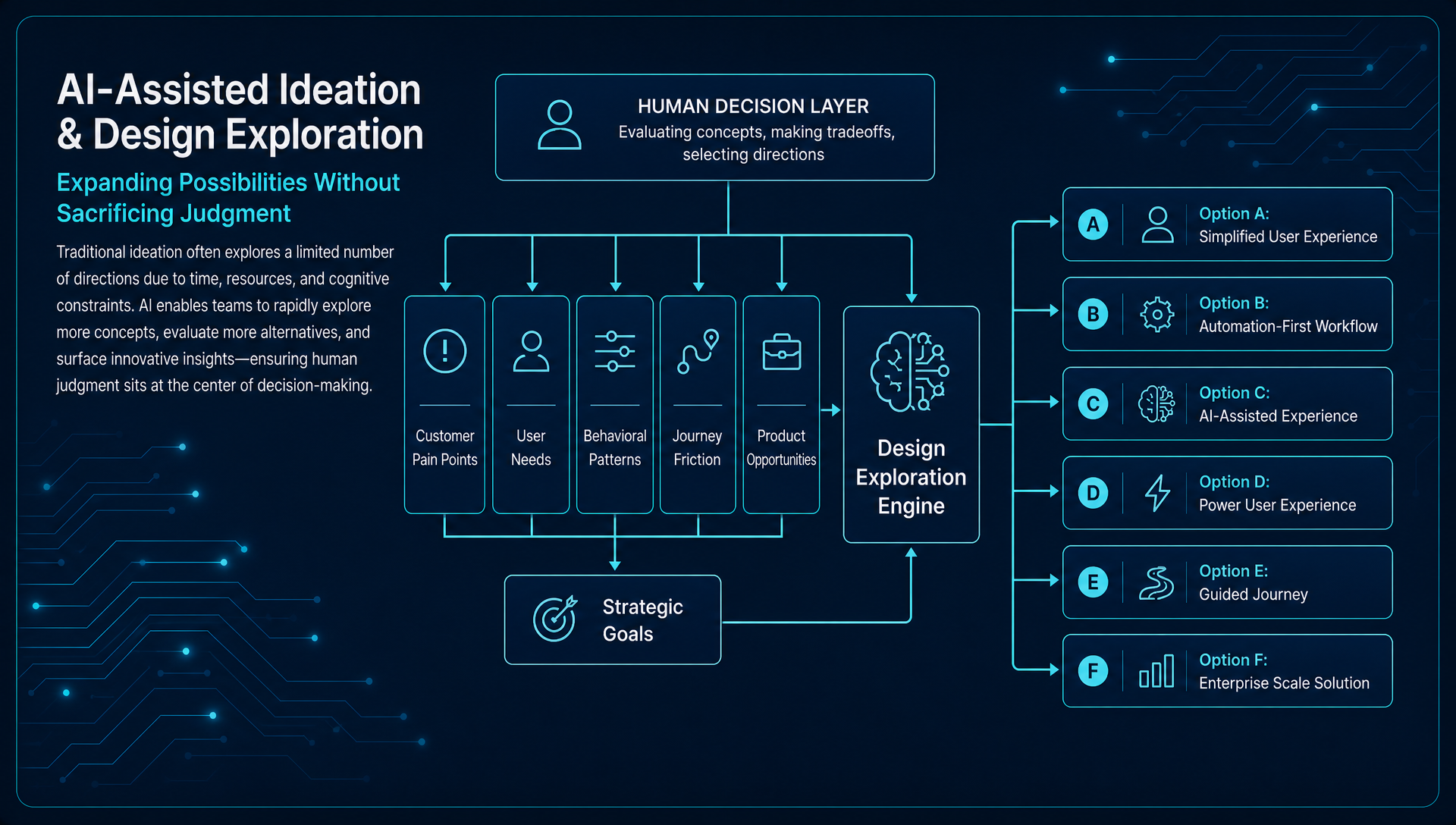
AI-assisted ideation and design exploration.
Expanding possibilities without sacrificing judgment.
Traditional ideation limits designers to exploring only two or three directions due to velocity constraints. Our design exploration engine expands this landscape, generating a wide variety of structurally valid conceptual paths simultaneously, while keeping human product judgment at the absolute center of the decision layer.
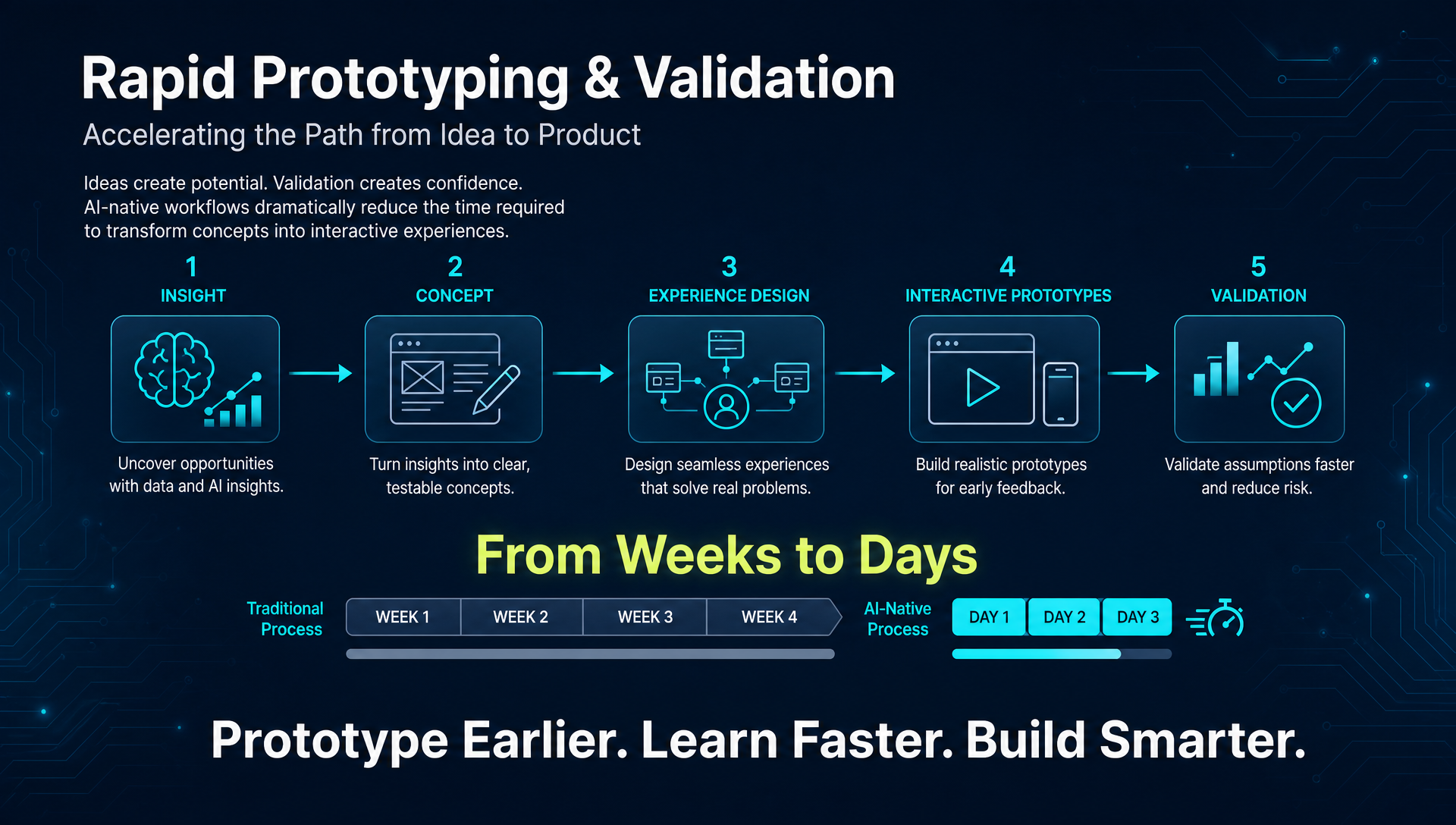
Rapid prototyping and validation.
Ideas create potential, but rapid validation builds organizational confidence. Integrating Claude, Cursor, Lovable, Framer, and Figma into an automated, interactive delivery loop reduces the timeline to transform high-fidelity concepts into fully testable digital experiences down to mere hours.
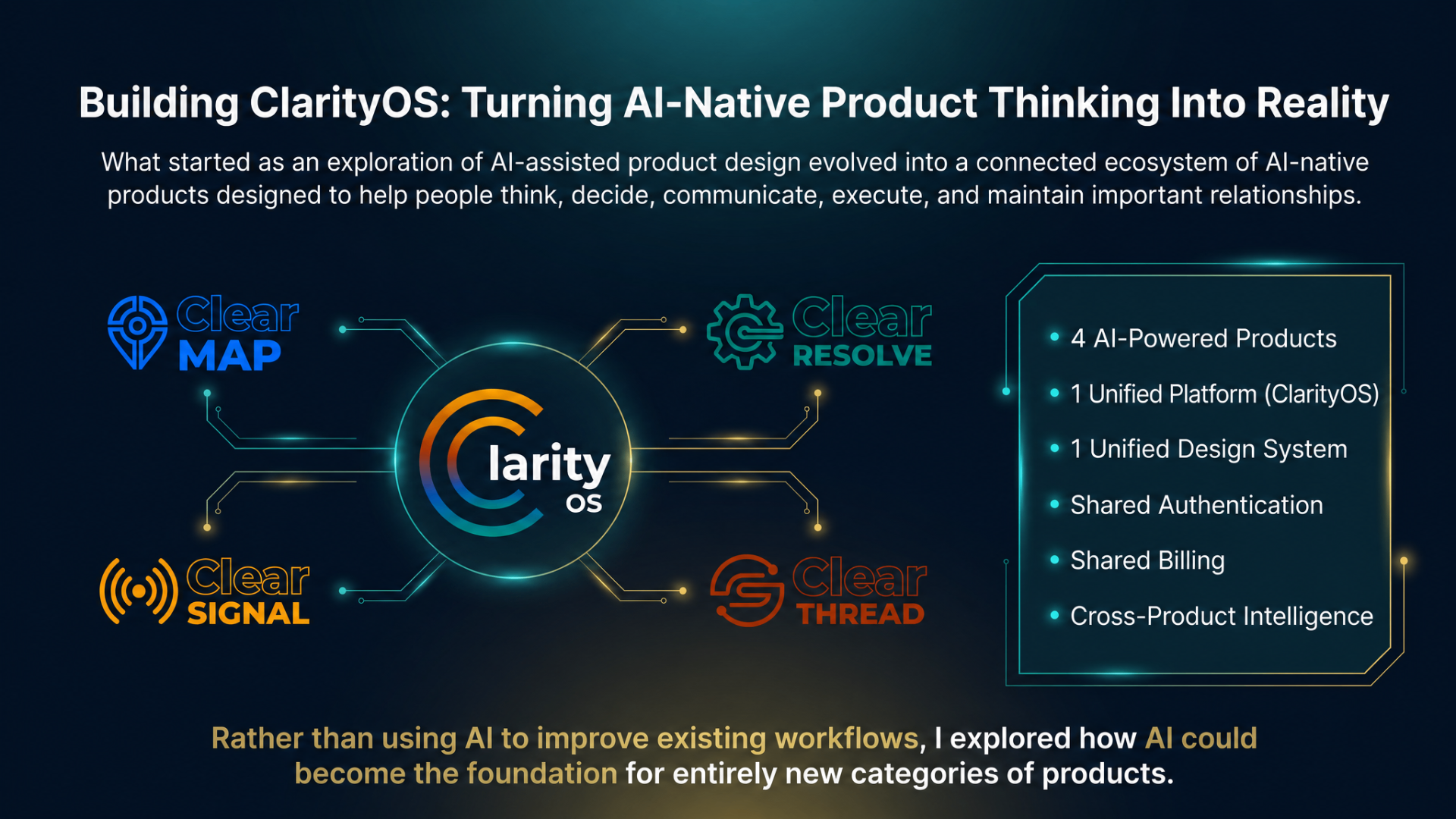
Building ClarityOS, turning AI-native product thinking into reality.
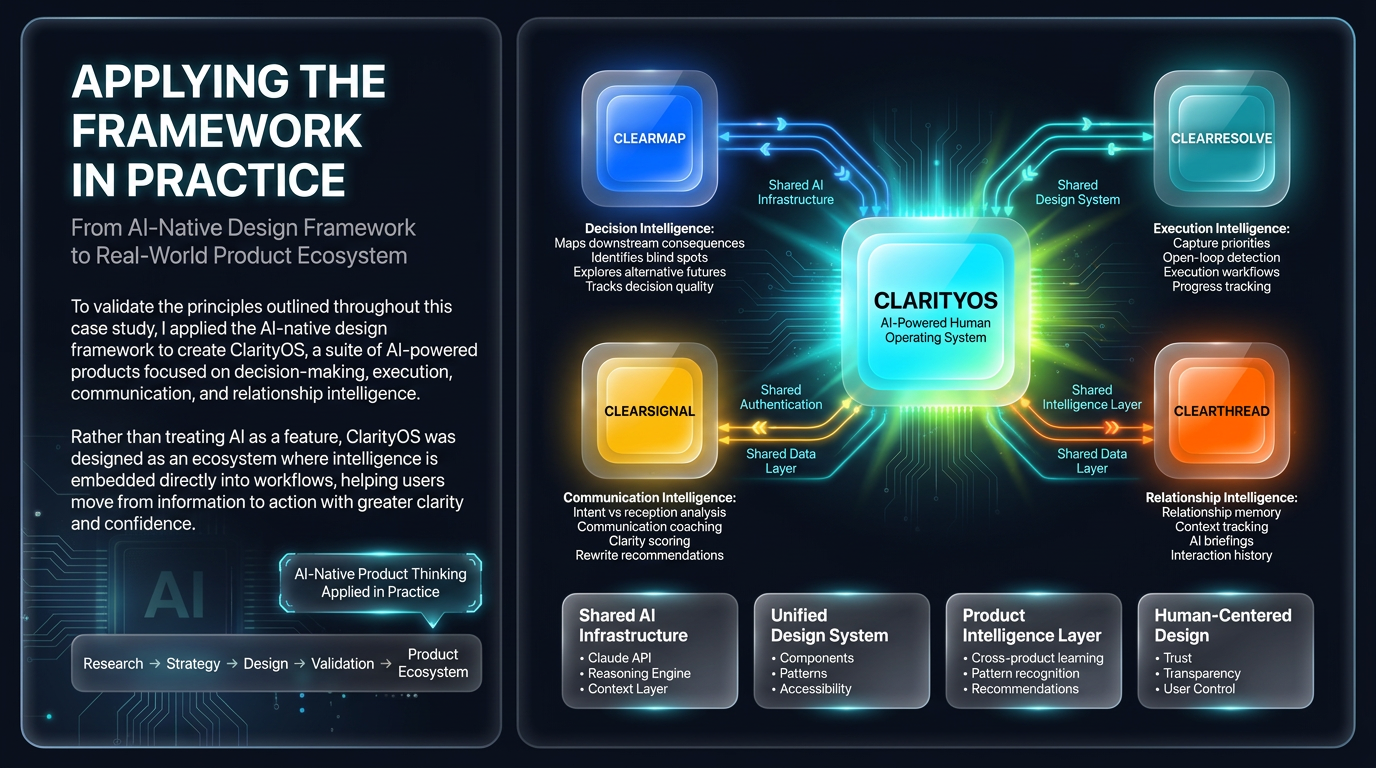
What started as an architectural exploration of AI-assisted design patterns quickly evolved into ClarityOS, a fully connected enterprise ecosystem of four AI-native platforms engineered to streamline business reasoning and eradicate collaboration clutter.
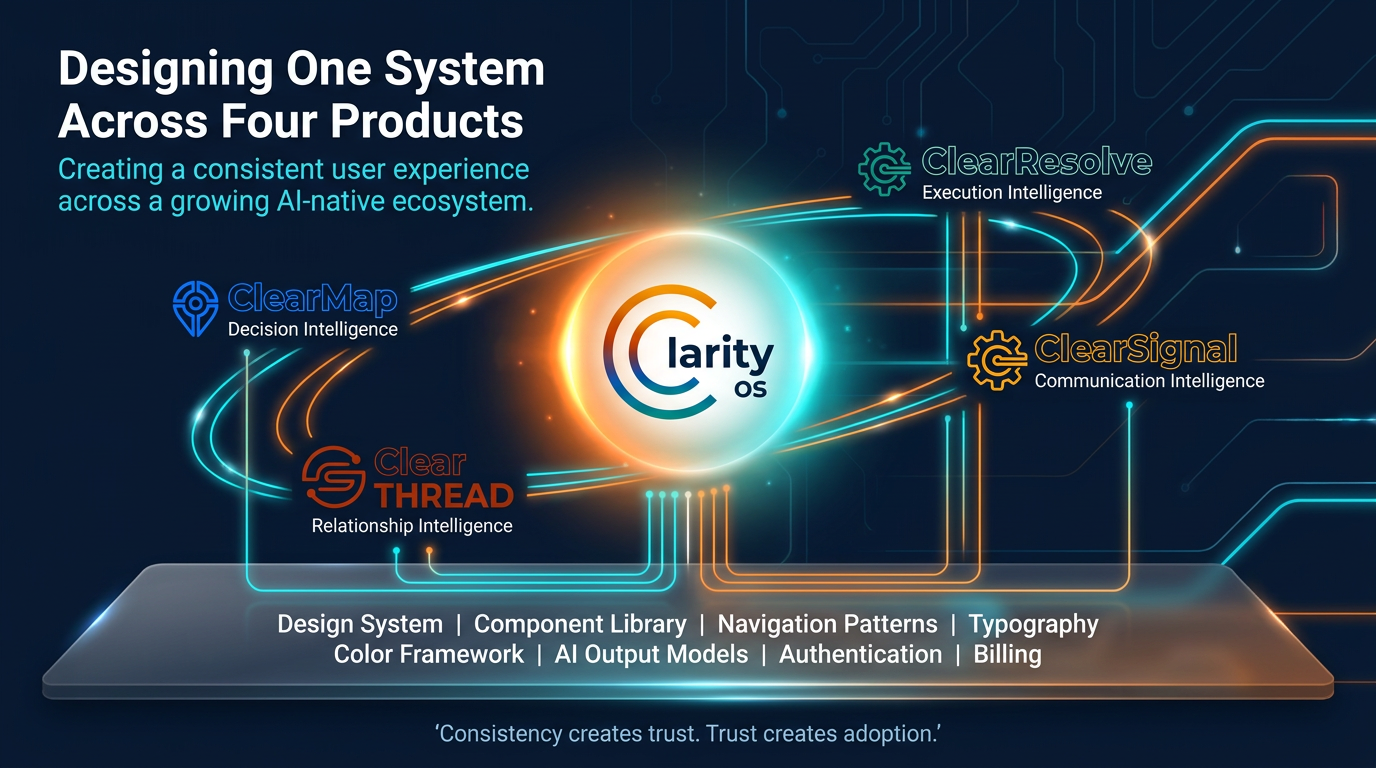
Designing one system across four products.
Consistency creates trust. Trust drives user adoption.
- Unified Component Library
- Shared Authentication
- Shared Billing
- Cross-Product Intelligence Layer
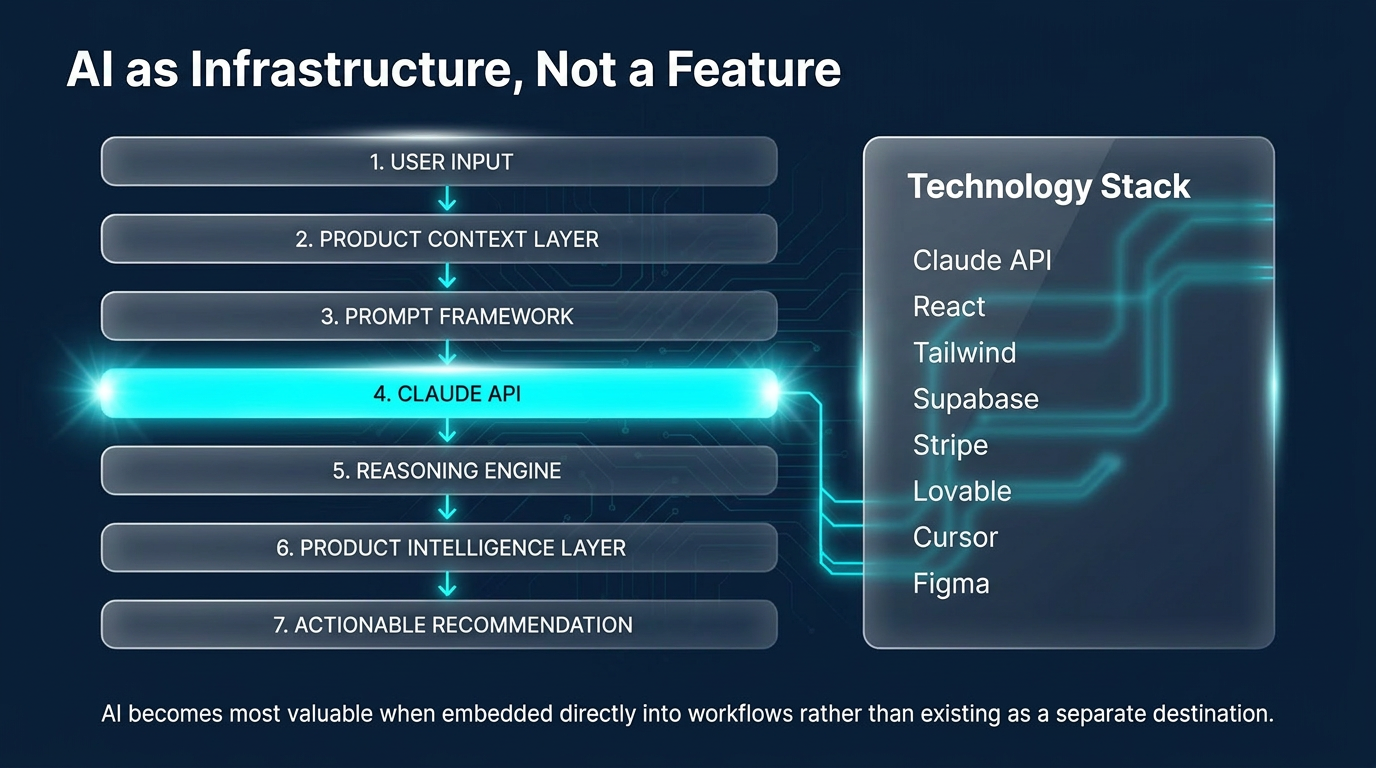
AI as infrastructure, not a feature.
- Claude API
- Reasoning and synthesis engine
- React
- Component-driven UI layer
- Tailwind CSS
- Design token implementation
- Supabase
- Database, auth, and realtime
- Stripe
- Billing and subscription rails
- Lovable
- AI-native product delivery
- Cursor
- AI-assisted engineering workflows
- Figma
- Design system and specification
- 01User Input
- 02Context Layer
- 03Prompt Framework
- 04LLM / Claude API
- 05Reasoning Engine
- 06Product Intelligence Layer
- 07Actionable UX Output
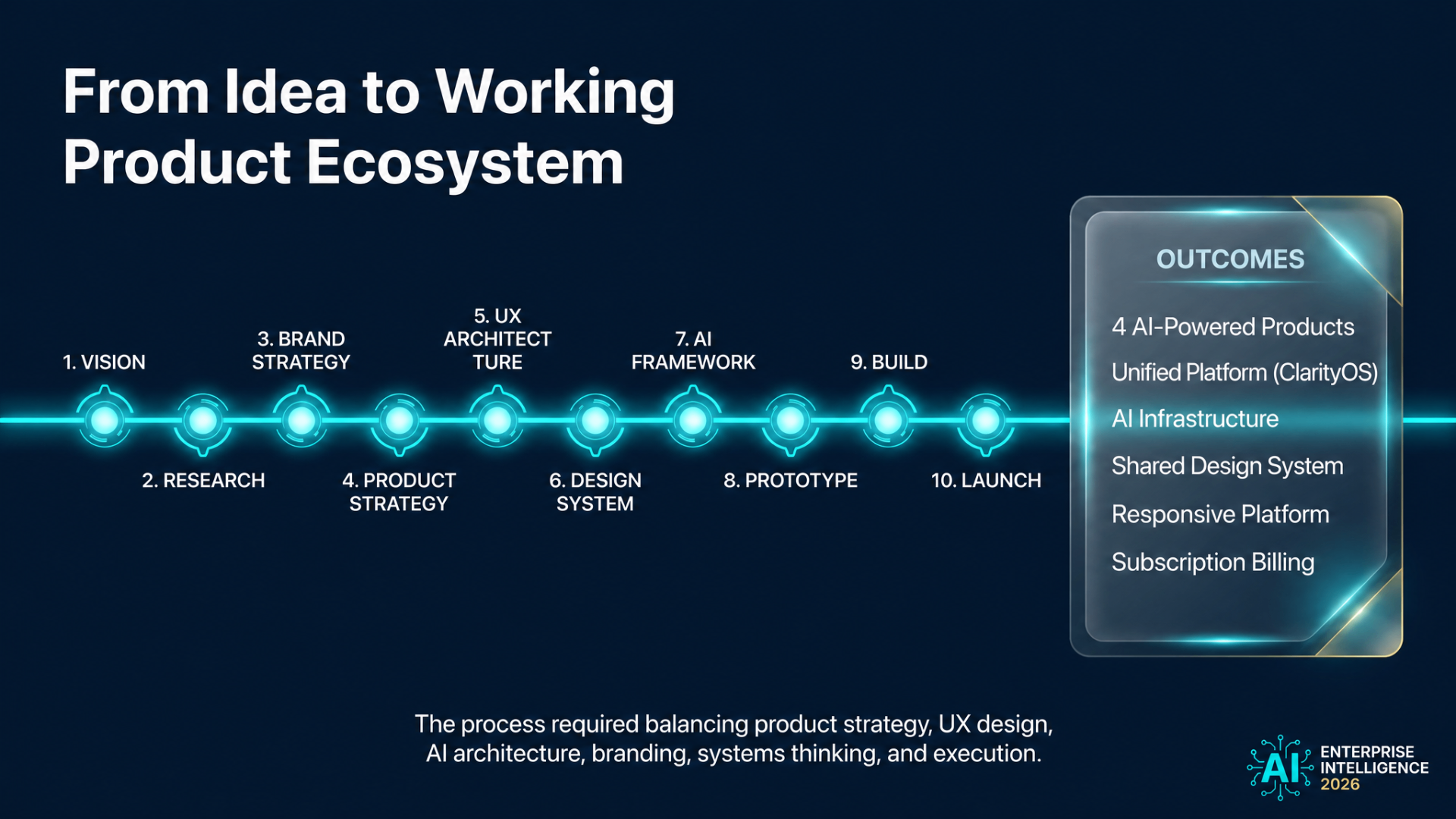
From idea to working product ecosystem.
Balancing strategy, architecture, branding, and execution. Transitioning from a conceptual design framework to a live, functional, multi-platform SaaS product requires structured lifecycle phases. The roadmap ensures every step, from initial vision to active code production, directly serves user requirements and business parameters.
Applying the framework in practice.
A detailed deep-dive into the ClarityOS product suite. Rather than treating intelligence layers as an isolated dashboard feature, ClarityOS embeds targeted reasoning engines directly into specialized user actions. Each sub-platform is designed to solve a unique domain layer while operating off a shared database and tokenized design system.
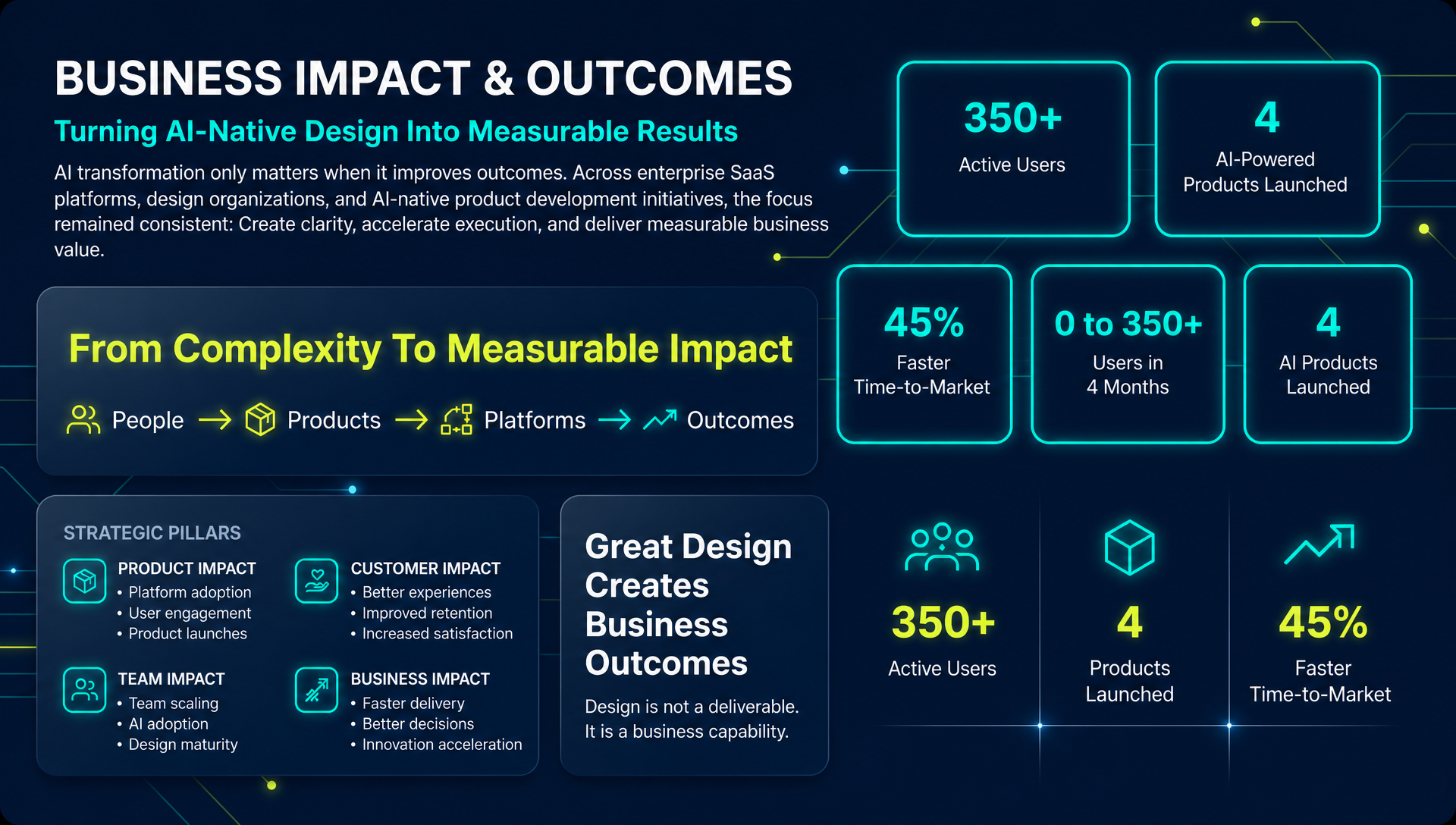
Turning AI-native product design into measurable value.
Strategic design is not simply an aesthetic deliverable, it is a core business capability. By fundamentally redesigning product development paradigms, we achieved step-function improvements in platform speed, iteration velocity, and organizational efficiency.
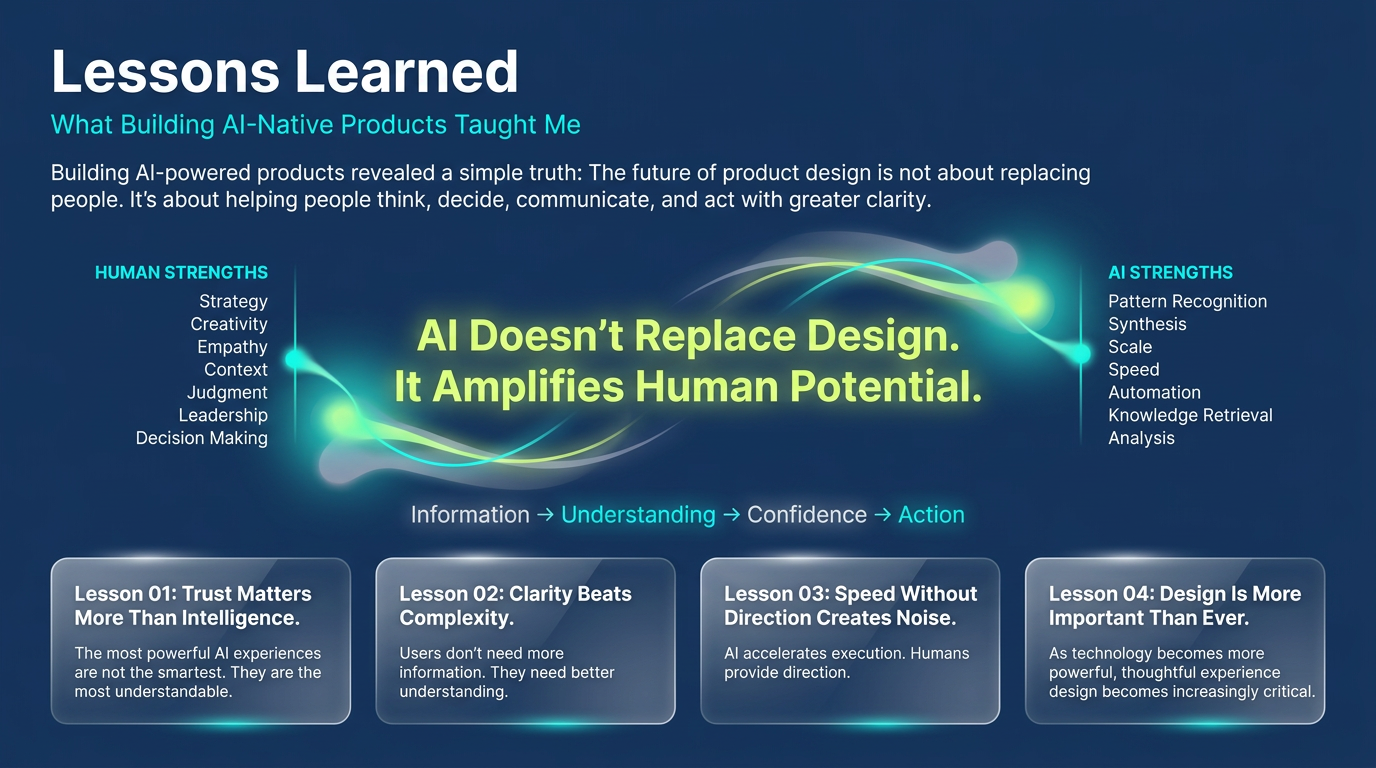
What building AI-native products taught me.
Pioneering workflows at the intersection of complex language models and user interface architecture reveals fundamental truths about the future of software development. AI does not render UX design obsolete, it elevates the strategic necessity of thoughtful product thinking.
The future of product design.
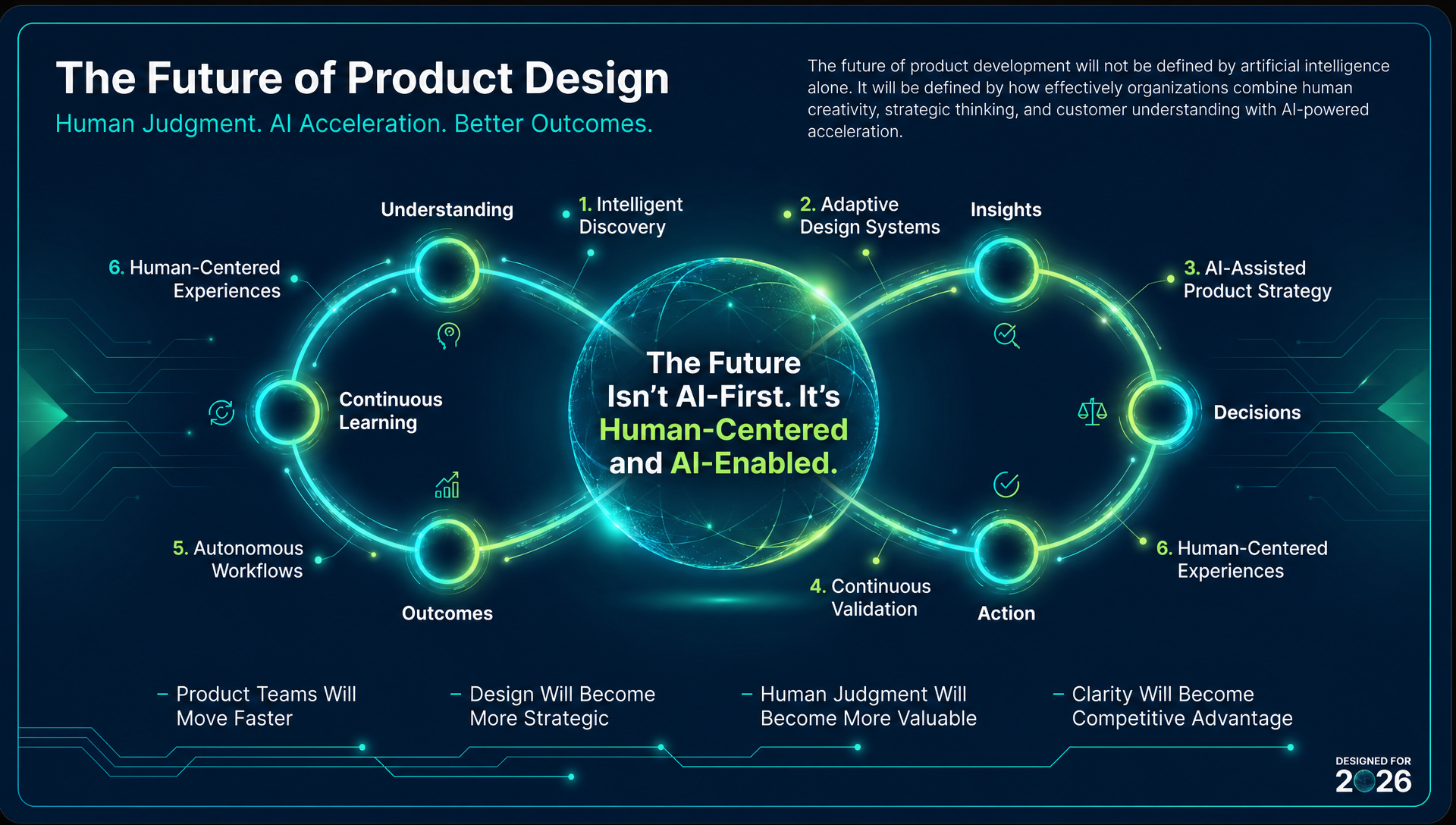
Coordinating human intelligence with machine acceleration. The next generation of enterprise tools will not be defined by raw computing power alone. Success will belong to organizations that elegantly combine strategic human judgment, high-empathy customer understanding, and machine intelligence into trust-first feedback loops.